
Architectural Lighting
Fixtures, layers and control — Ensanche Naco, Santo Domingo
Lighting is the part of a house nobody points at and everybody feels. A room with the right fixtures in the wrong places reads as cold, flat or restless, and no amount of furniture fixes it. The work is not choosing a beautiful lamp: it is deciding where light lands, how wide the beam is, what colour it is at eight in the morning and what colour it is at eight at night.
We specify and install the fixtures, and we commission the control that drives them. Those are two different disciplines and they are usually bought from two different places, which is exactly why so many installations end up with excellent hardware on a switch that nobody understands. Here they are drawn together, on the same plan, by the same team.
The lighting brands we carry
Three manufacturers, three different jobs

Lucifer Lighting
Architectural, specification grade
A family-owned manufacturer that designs and builds everything on one campus in San Antonio, Texas. Recessed downlights, adjustable accent fixtures, wall washers, track and bollards, with the small apertures and deep regression that architects ask for when the ceiling is meant to look empty. This is what goes over art, stone and millwork.

WAC Lighting
The widest range, indoors and out
A second-generation family manufacturer with more than thirty-five years in LED, and the broadest catalogue of the three: recessed and track, under cabinet, indoor and outdoor tape, decorative pendants and sconces, and a full landscape line of bollards, path and accent fixtures. When a house needs one language from the entrance gate to the kitchen island, it usually starts here.

ELCO Lighting
Volume, availability, service spaces
Recessed residential and commercial, cylinders, track, under cabinet, pathway, outdoor and tape. ELCO builds its business on stock and same-day shipping, which matters more than it sounds: it is what lets a service corridor, a laundry or a staff area be finished properly instead of being left with whatever the electrician had in the van.
Specifying three manufacturers in one house is normal and deliberate. A downlight aimed at a painting and a fixture lighting a pantry are not the same product and should not cost the same. What has to stay constant across all of them is the colour temperature and the dimming behaviour, and that is a decision made once, at the start.
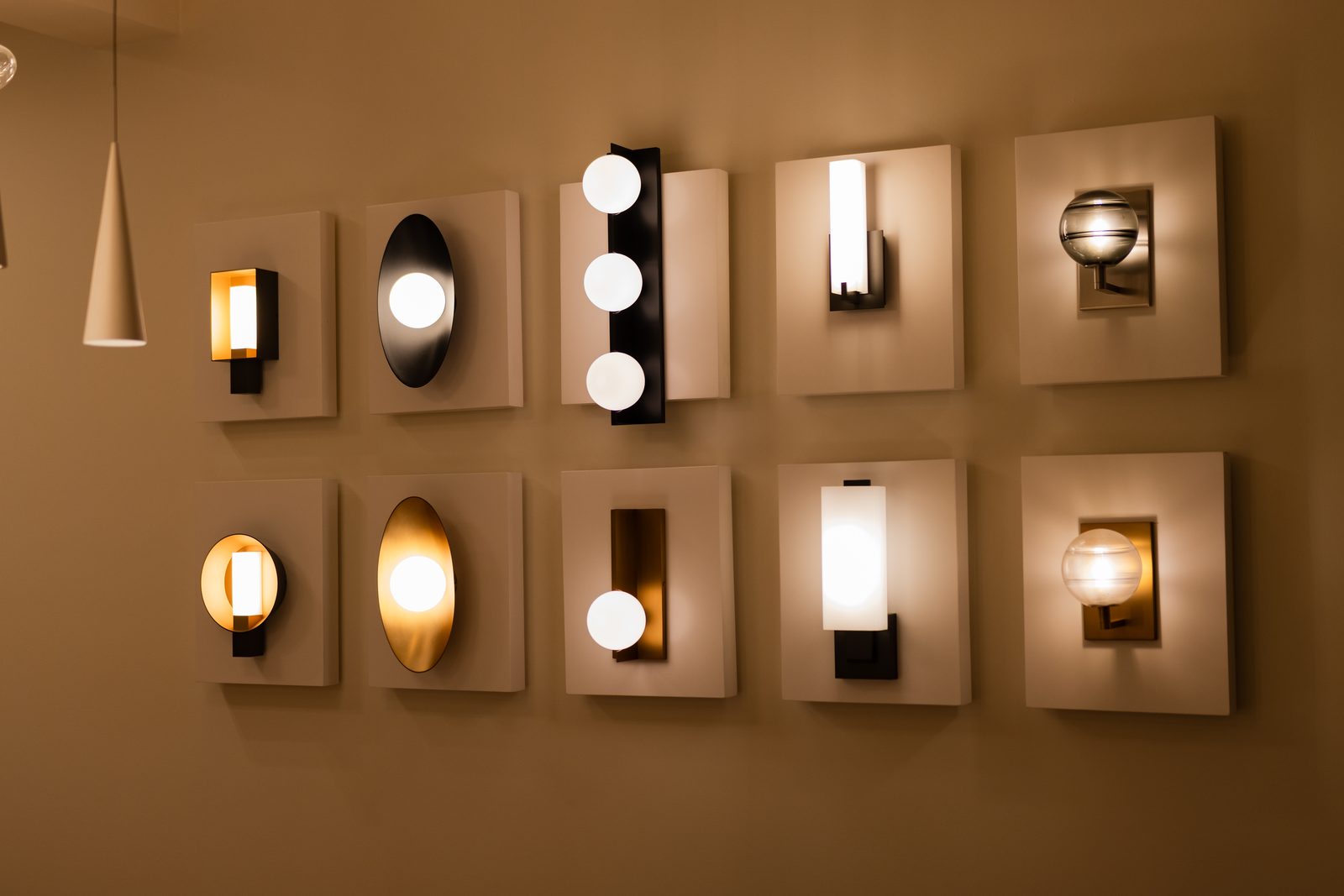
Ten sconces on one wall of our showroom, all of them lit. The difference between two fixtures is easier to see here in ten seconds than in a catalogue in ten minutes.
How a lighting layout gets decided
Three questions, in this order
Layers, not a ceiling grid
Ambient light so the room is comfortable, task light where someone actually works, accent light on the things worth looking at. A ceiling covered in evenly spaced downlights is the most common mistake in a finished house: it lights the floor and leaves the walls dark, which is what makes a large room feel like a lobby.
Beam angle and glare
Two fixtures with the same output can look nothing alike. Aperture size, beam spread, how deep the source sits inside the housing and which trim is used decide whether you see the light or the fixture. In a room with high ceilings and polished floors, glare control is the difference between elegant and uncomfortable.
Colour and dimming
One colour temperature across the house, or tunable white that shifts through the day. Either way the fixtures and the dimmers have to agree, or the light flickers at the bottom of the curve and never reaches zero. We commission that on site, with you in the room, and set the scenes to Santo Domingo sunrise and sunset rather than a fixed hour.
Outside the house
Facade, garden and terrace
Half of this discipline happens outdoors, and all three manufacturers build for it. A facade is lit from the ground up or grazed along its own texture; a garden is lit in layers, the same way a room is; a terrace has to work at a level low enough to leave the view of the sea or the city intact.
The Caribbean is hard on outdoor fixtures. Salt air, rain and sun decide which finishes survive, so out here the specification is about ingress ratings, gaskets and materials before it is about looks. We run it at low voltage where the layout allows, on the same timeclocks as the interior, so the house dims outside and inside as one thing instead of two.
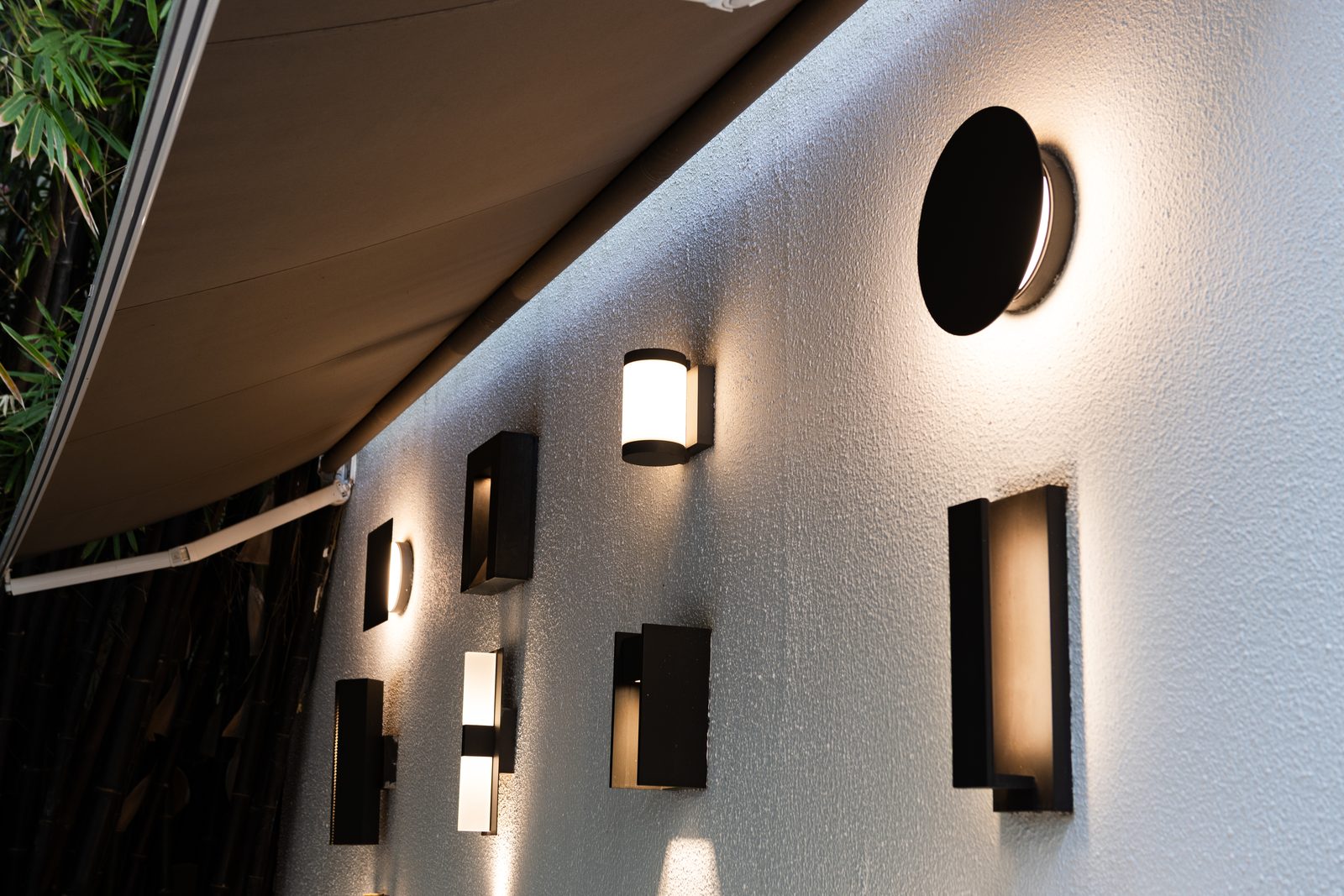
Exterior fixtures on the showroom wall, lit. Outdoors the finish is not decoration: it is what decides how long the fixture lasts.
Fixtures and control are one system
Everything above is hardware. What turns it into a house that behaves is the control layer, and for that we work with Lutron: dimming and tunable white across every room, astronomical timeclocks, keypads chosen by hand, and shading that answers to the same scenes so daylight and electric light stop fighting each other. The two pages are worth reading together — Lutron covers the control side, and motorized shades the daylight.
Availability is the last question and never the first. What a manufacturer lists in its catalogue is not always what can be ordered and delivered in the Dominican Republic, so we confirm lead times and finishes before anything is specified in a drawing.